
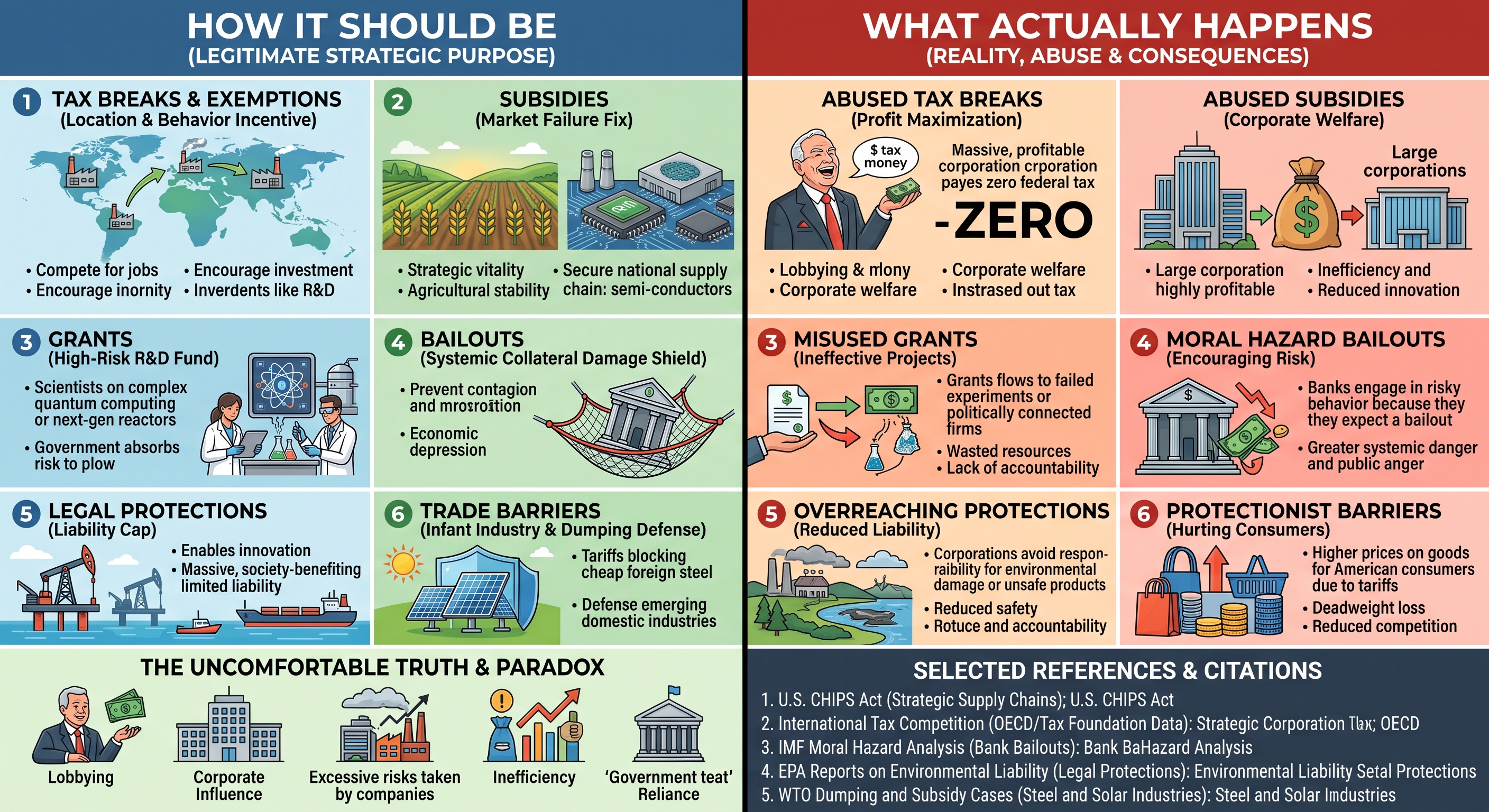

Legitimate strategy or corporate welfare? A closer look at the policies that prop up big business.
From the public’s viewpoint, these tools look like “corporate welfare.” But from the perspective of corporate boards, economists, and policymakers, these are not about “survival” in the sense of keeping the lights on. They are about risk management, global competitiveness, and steering economic behavior.
Here is why each tool is used, broken down by its strategic purpose:
1. Tax Breaks and Exemptions (The “Location” and “Behavior” Incentive)
- The “Race to the Bottom”: Corporations do not need tax breaks to exist; they need them to choose where to exist. In a globalized economy, a company can put its headquarters in Ireland, its factories in Vietnam, and its R&D in the US. Tax breaks are the “bribe” that convinces them to plant those jobs in a specific state or country rather than a competitor’s.
- Behavioral Steering: Exemptions are rarely given for just “being a company.” They are given for specific actions—like R&D tax credits (to incentivize innovation) or accelerated depreciation (to incentivize buying new equipment). Without these, companies would invest less in long-term capital.
2. Subsidies (The “Market Failure” Fix)
- Subsidies are used when a product is strategically vital but not profitable at market prices. For example, agricultural subsidies keep domestic farms alive so the US isn’t 100% reliant on foreign food in the event of a war. Chip manufacturing subsidies (like the CHIPS Act) are used because private equity refuses to fund expensive domestic fabrication plants when building in Taiwan is cheaper. The subsidy isn’t for the company’s survival; it’s for the nation’s supply-chain survival.
3. Grants (The “High-Risk R&D” Fund)
- Grants are essentially free money for projects that have no immediate ROI. Corporations cannot justify spending billions on experimental quantum computing, next-gen nuclear reactors, or COVID-19 vaccine platforms to their shareholders because the failure rate is too high. The government issues grants to de-risk this frontier science. The corporation survives the experiment failing because the grant absorbed the loss.
4. Bailouts (The “Systemic Collateral Damage” Shield)
- This is the most controversial one. When a massive bank (2008) or an airline (2020) fails, it isn’t just that company that dies. Suppliers go under, employees lose healthcare, pension funds collapse, and consumer confidence plummets. Bailouts are not to save the CEO’s bonus; they are to prevent contagion. The government steps in because the cost of the bankruptcy (economic depression) is exponentially higher than the cost of the bailout.
5. Legal Protections (The “Liability Cap”)
- This includes things like limited liability (shareholders can only lose what they invested, not their personal homes) and caps on lawsuit damages. Without limited liability, no one would invest in oil drilling, pharma, or aviation, because a single catastrophic accident could bankrupt the investors personally. Legal protections allow corporations to take on the massive, society-benefiting risks that no individual would accept alone.
6. Trade Barriers (Tariffs and Quotas) (The “Infant Industry” and “Dumping” Defense)
- Trade barriers are rarely about a mature corporation surviving. They are about “infant industries” (e.g., early US solar panel makers) that cannot compete with cheap Chinese state-subsidized imports. Without tariffs, the domestic industry dies before it ever gets big enough to achieve economies of scale.
- They are also used as anti-dumping measures—if a foreign government is unfairly subsidizing its steel, they can sell it in the US below cost, destroying US steel mills. Tariffs block that predatory pricing.
The Uncomfortable Truth (The “Crony” Factor)
While these tools have legitimate economic justifications, they are frequently abused.
In reality, large corporations have lobbyists who push for these supports not for noble economic reasons, but for profit maximization. Many mature, profitable companies use tax breaks to pay zero federal tax (which they legally should), or push for trade barriers to kill competition so they can raise prices on American consumers.
The ultimate paradox: Proponents argue these supports make corporations “survive” so they can hire workers. Critics argue these supports actually make corporations weaker—because when a company knows a bailout or subsidy is coming, it takes excessive risks, becomes inefficient, and relies on the government teat rather than innovating.
In short, corporations don’t need these tools to exist; they need them to win in a rigged global game. The government provides them not out of charity, but out of a calculated trade-off: “We will give you this advantage, provided you keep our citizens employed and our nation technologically dominant.” Whether that trade-off is worth it is the central debate of modern capitalism.
Leave a Reply