

The Accidental Precedent: How a Court Reporter’s Note Shaped Corporate Rights
The idea of a corporation acting as a “person” is a long-standing “legal fiction” that has had a profound and controversial impact on American law. This concept was originally created to allow companies to own property and sue in their own name. Its application to constitutional rights began with a surprising, non-legal note added to a Supreme Court case summary by a railroad-friendly court reporter in 1886.
What is a “Legal Person”?
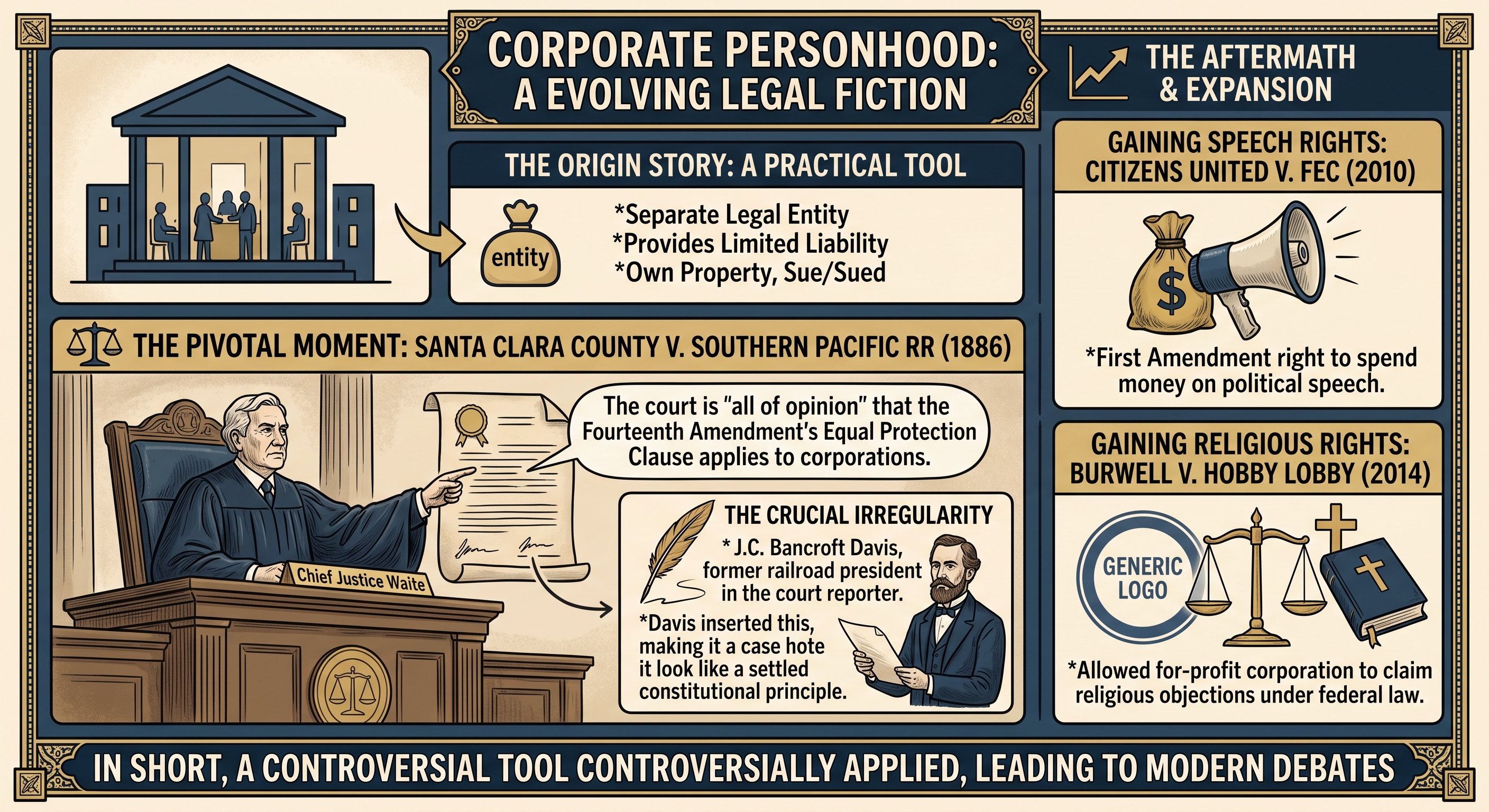
The doctrine of “corporate personhood” refers to the legal definition of a corporation as a single entity, separate from its owners. A corporation can do many of the same things a real person can:
- Sign contracts
- Buy and sell property
- Sue and be sued in a court of law
Crucially, this legal status allows the corporation to have a “separate legal entity,” which is the foundation of “limited liability.” Limited liability protects individual shareholders, meaning they are generally not personally responsible for the corporation’s debts or wrongdoings.
The Pivotal Moment: A Reporter’s Note in 1886
The expansion of this legal fiction into the realm of constitutional rights can be traced back to Santa Clara County v. Southern Pacific Railroad in 1886. The actual legal issue in the case was about a specific tax on railroad property, and the Supreme Court’s official decision addressed only this narrow point.
However, before the oral arguments even began, Chief Justice Morrison Waite stated to the lawyers that the court was “all of opinion” that the Fourteenth Amendment’s “Equal Protection Clause,” which prevents states from denying equal rights to persons, also applied to corporations.
This statement was not part of the court’s official written decision, yet it appeared in the case’s “headnotes,” a summary of the ruling published in official reports. This insertion was done by J.C. Bancroft Davis, the court reporter who also happened to be a former president of a railroad company. This “crucial irregularity” has been cited by subsequent courts as the official precedent, making it seem like a settled constitutional principle when it was, in fact, just a reported observation.
The Aftermath and Constitutional Expansion
This informal, irregular insertion of corporate rights into the constitutional landscape planted the seed for numerous other rights to be applied to corporations:
- First Amendment Rights to Spend Money: In the controversial Citizens United v. FEC (2010), the court ruled that corporations have the same First Amendment free speech rights to spend money on political causes as individuals, citing the established “corporate person” doctrine.
- Religious Freedom Rights: In Burwell v. Hobby Lobby (2014), the court expanded the doctrine even further, allowing a for-profit corporation to claim religious objections to a federal law, a move that critics said stretched the definition of a “person” to protect a corporation’s “exercise of religion.”
While corporate personhood was initially a practical legal tool, its dramatic expansion from 1886 to the present day has allowed corporations to gain the same constitutional protections as human beings. This transformation is a significant factor in some of the most prominent legal and political debates of our time.
Leave a Reply