
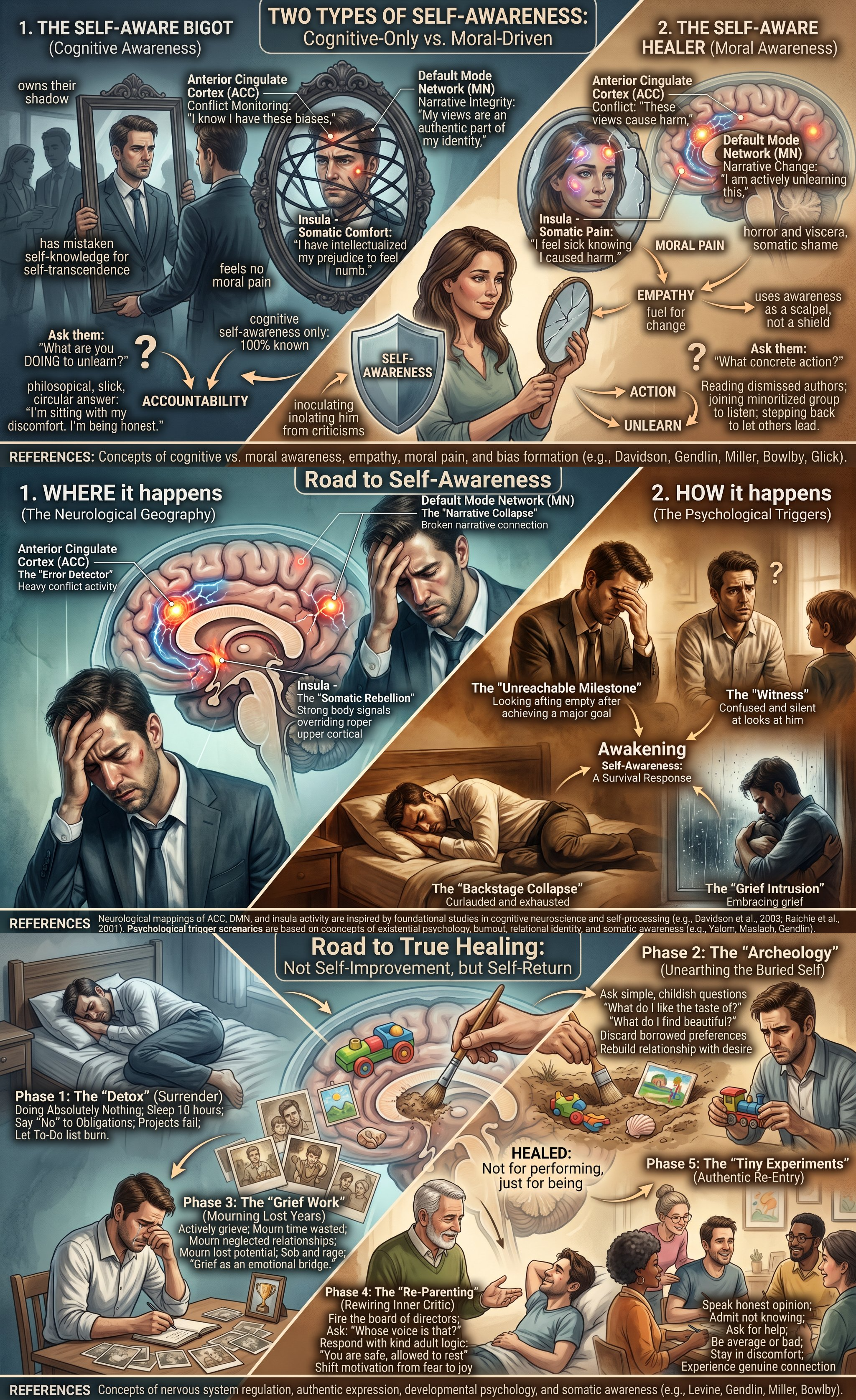

The Crucial Distinction: “Awareness” vs. “Change”
First, we have to split self-awareness into two categories:
- Cognitive Self-Awareness: “I know exactly what I believe, why I believe it, how I behave, and how others perceive me.”
- Moral Self-Awareness: “I know my beliefs cause harm, and I am motivated to change them because I value equity and human dignity.”
A racist or misogynist can have 100% of the first and 0% of the second. They can be profoundly cognitively self-aware. They know their biases. They know they treat women or other races differently. They know society condemns them. They have examined their own psychology and can articulate it perfectly.
They just don’t think it’s a problem. Or worse—they think it’s a virtue.
How This Happens: The Architecture of a “Self-Aware” Bigot
If you sat down with this person and asked them deep, probing questions, here is what their self-awareness would sound like:
- They own their shadow: They won’t gaslight you. They’ll say, “Yes, I feel a flash of anger when I see an interracial couple. Yes, I dismiss women’s opinions in meetings and only realize it afterward. I am aware of that.”
- They understand their origin story: They can trace it back. “My father was a blatant racist. I rebelled against him in college and dated outside my race, but after I got robbed, that old fear came roaring back. I know my racism is rooted in fear, not facts.”
- They know the social cost: They are fully aware that their views cost them friends, job opportunities, and social standing. They have chosen to pay that price anyway.
To an outside observer, this person appears incredibly self-possessed, honest, and psychologically sophisticated. They might even sound like they are working through it.
But here is the trap: They use their self-awareness as a shield, not a scalpel. They say, “I know I’m a misogynist. I’ve done the therapy. I’ve sat with my mother issues. This is just who I am, and I’ve accepted it.”
They have mistaken self-knowledge for self-transcendence. They believe that merely seeing the flaw is the same as fixing it. So they stop there.
Why Self-Awareness Alone Fails Them
For a self-aware bigot, their awareness actually becomes a sophisticated defense mechanism:
- It inoculates them against criticism: When you call them out, they say, “I already know that about myself. You’re not telling me anything new.” They rob you of your power to hold them accountable because they’ve already held themselves accountable in their own head—and acquitted themselves.
- It turns their bigotry into an identity: They wrap their prejudice into their “authentic self.” They say, “At least I’m honest about my darkness. Most people are fake. I’m real.” Their racism/misogyny becomes a badge of rebellious authenticity, rather than a wound to be healed.
- It creates a ceiling of justification: They use their self-awareness to create a neat, tidy narrative: “I am a flawed person, I see my flaws, therefore I am whole.” They never take the next excruciating step, which is: “I see my flaws, they cause real harm, and I must endure the painful, humiliating work of ripping them out by the roots.”
The Missing Ingredient: Empathy and Moral Pain
The difference between a self-aware bigot and a self-aware person who actually heals from bigotry is moral pain.
When a genuinely healing person becomes aware of their racism or misogyny, they feel horror. They feel sick to their stomach. They think about the specific women they dismissed, the specific people of color they feared, and they feel a visceral, somatic shame. They don’t just know they caused harm; they feel the harm they caused. That pain is the fuel for change.
The self-aware bigot feels no such pain. Or if they do, they have intellectualized it into numbness. They have understood their prejudice so thoroughly that they have drained it of its emotional charge. They are comfortable with it.
And comfort with your own capacity to dehumanize others is the death of moral growth.
The Ultimate Litmus Test
Here is how you tell the difference between a truly self-aware person working on their bigotry, and a self-aware person who is just a polished bigot:
**Ask them: “What are you doing, right now, today, to actively unlearn this? What concrete action are you taking to make amends or change your behavior?” **
- The genuine healer will have a specific, uncomfortable answer: “I’m reading books by authors I used to dismiss. I’m joining a group where I am the minority and I sit in silence and listen. I’m apologizing to my female colleagues and stepping back to let them lead.”
- The self-aware bigot will give you a philosophical, slick, circular answer: “I’m sitting with my discomfort. I’m being honest about who I am. I’m not pretending to be something I’m not.”
Notice the difference? One is doing—taking risky, humiliating, external action. The other is navel-gazing—keeping everything safely inside their own head, where they remain in control.
The Hard Truth
Self-awareness is morally neutral. It is simply the ability to see yourself clearly.
A knife does not care if it is used to perform surgery or to stab someone. Self-awareness is the same. In the hands of someone who values power and dominance, it becomes a tool for sophisticated self-justification. In the hands of someone who values connection and justice, it becomes the first painful step toward becoming less of a monster.
So yes, that person you are thinking of? They might be brilliantly self-aware. They might be able to write a dissertation on their own prejudice.
But until they are bothered by it—until their own reflection makes them physically uncomfortable enough to change—they are not healed. They are just a well-lit version of the same darkness.
Leave a Reply